The Challenge
Research brings important ideas forward. How those ideas are presented can help people understand their meaning and see where they might lead.
The study, Concept Mapping STI/HIV Prevention and Condom Use among Young African American Adults, explored participants’ perspectives on prevention and identified seven conceptual domains.
The challenge was to translate a detailed publication into a research poster that felt clear and approachable while preserving the study’s context. Readers needed to understand who participated, how the research was conducted, what emerged, and what the findings could—and could not—tell us.
The Goal
Create a research poster that helps people find the main message, explore the findings, and understand their relevance to health communication.
The poster needed to work at different levels of attention. Someone walking past should be able to recognize the central finding. Someone spending more time with the board should be able to follow the methods, compare the results, and consider the implications.
Our goal was to make the research easier to engage with while keeping its meaning intact.
Our Approach
We organized the poster around four questions:
Why does this matter? → How was it studied? → What did participants prioritize? → What could come next?
Provide Context
Introduce the study’s purpose and population so readers understand whose perspectives the findings reflect.
Show the Process
Break the concept-mapping procedure into a clear sequence: discuss, sort and rate, then map.
Make the Findings Visible
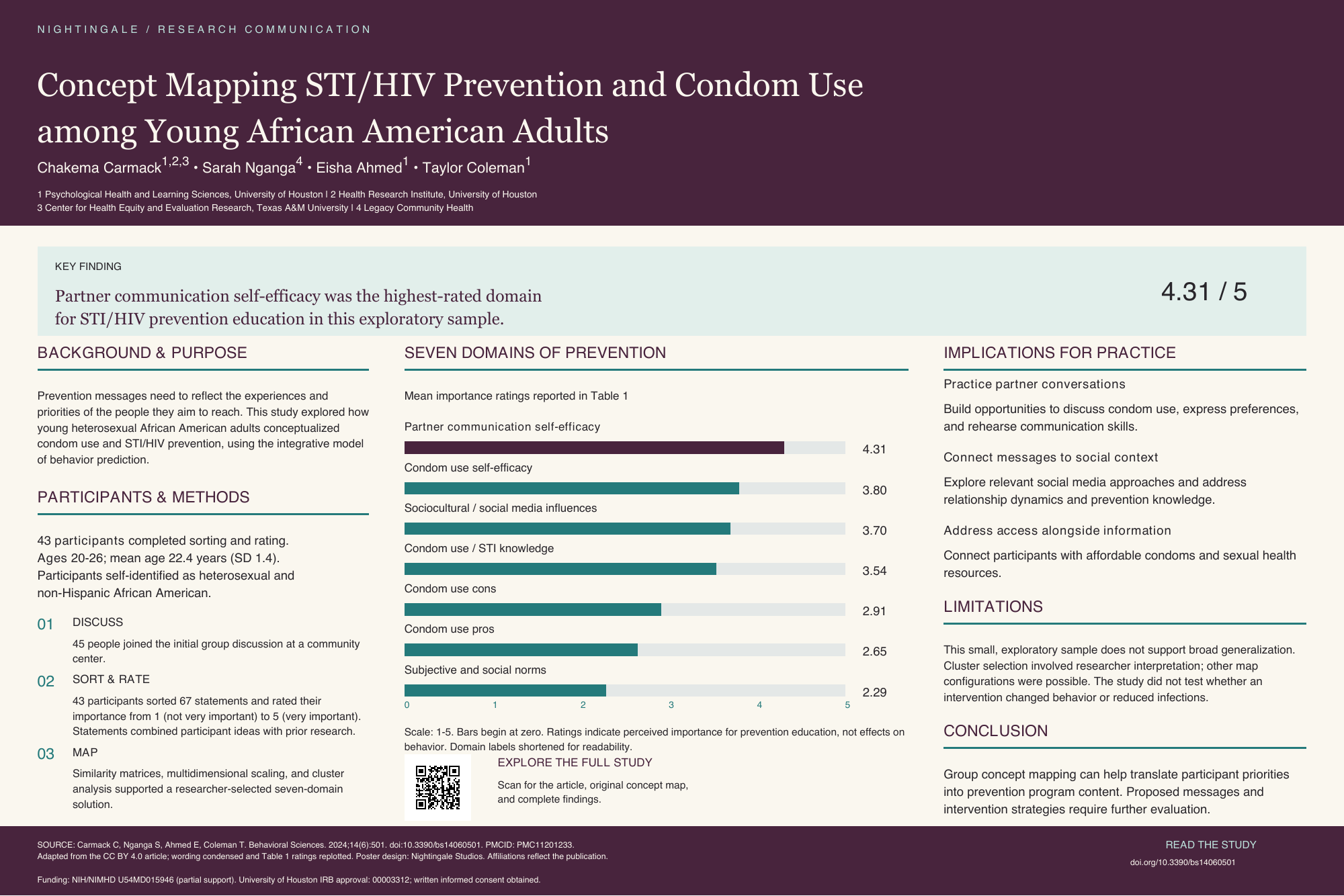
Present the seven domains in a horizontal bar chart, allowing readers to compare the reported importance ratings.
Connect Findings to Possibilities
Explain how the results could inform prevention messaging while keeping limitations and the need for further evaluation visible.
Together, these decisions create a path through the research without asking readers to absorb the full publication at once.
The Creative Direction
The visual direction brings together deep plum, teal, and ivory.
Deep plum anchors the title and section headings. Teal connects the supporting information and chart elements, while ivory gives the content room to breathe. A pale teal panel introduces the main finding near the top of the poster.
The three-column layout supports a clear reading order. Background and methods establish the context on the left. The results take the largest share of attention in the center. Practice implications, limitations, and the conclusion complete the story on the right.
A serif title gives the poster a distinct identity, while simple body typography supports reading across the board. Short sections, consistent labels, and intentional spacing help readers find their place.
Each design choice serves the same purpose: make the research easier to enter, follow, and return to.
From Findings to Visual Communication
The highest-rated domain—self-efficacy for partner communication—became the poster’s central takeaway.
Its mean importance rating of 4.31 out of 5 appears in the summary panel and is highlighted in plum within the chart. The remaining domains use teal, creating emphasis while keeping all seven findings visible.
The chart includes exact values and an explanation of the rating scale. It also clarifies that the scores reflect participants’ views about importance for prevention education. They do not represent infection rates, behavior change, or intervention effectiveness.
This distinction shaped the writing throughout the poster. Implications are presented as directions for developing and testing prevention messages. Limitations remain part of the main layout, where readers can consider them alongside the findings.
For Nightingale, clarity includes helping people understand the boundaries of the evidence.
The Solution
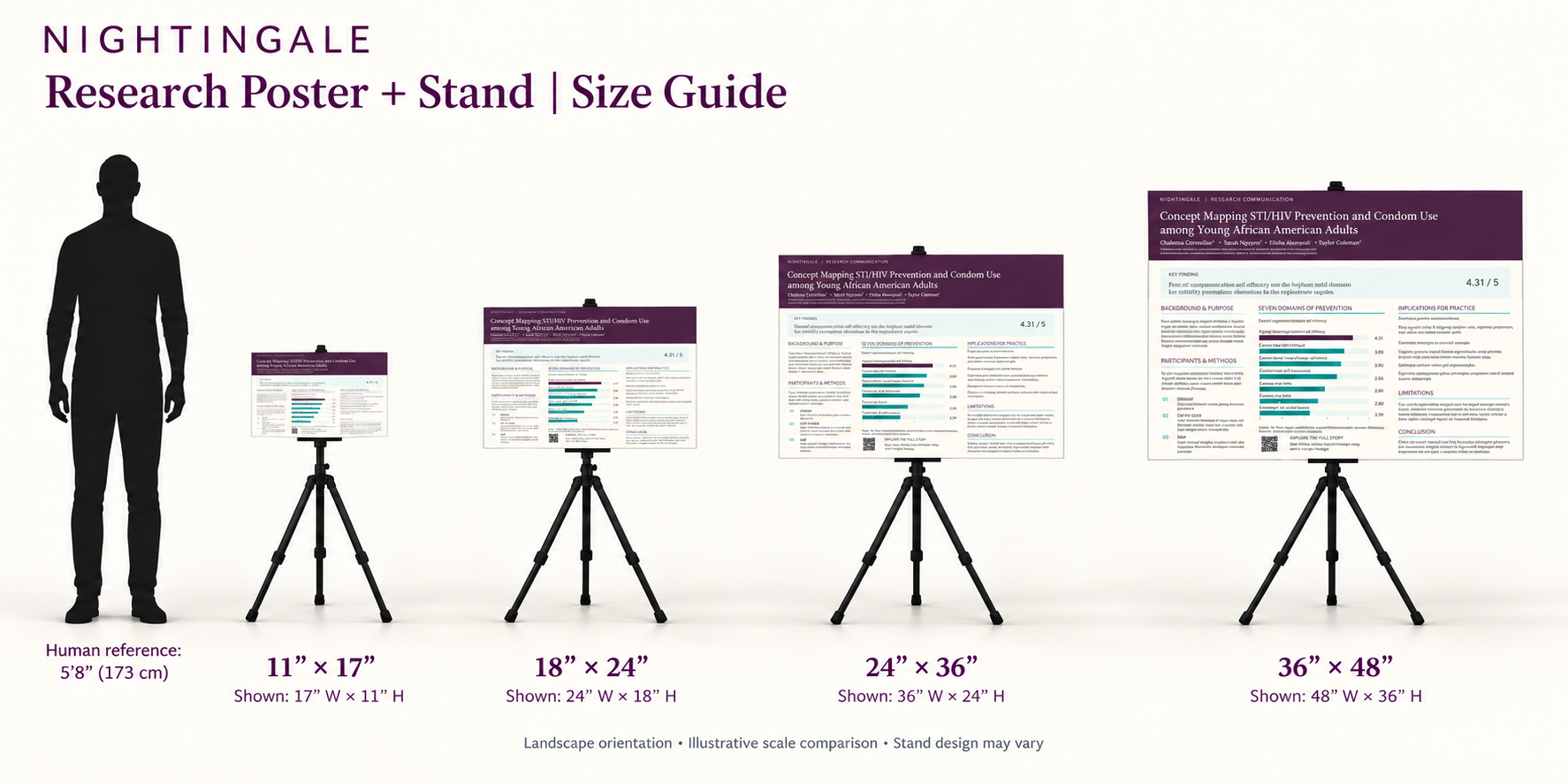
The finished research poster brings study context, methods, findings, and interpretation into one coordinated presentation. It is designed to accommodate a range of sizes to meet each client’s display and presentation needs.
Understand the context. • Follow the process. • Explore the findings. • Consider the next step.
The poster includes the study authors and affiliations, publication reference, funding and ethics information, and a QR code connecting readers with the full article.
The result gives the research a visual structure while keeping the original publication available for deeper exploration.
The Intended Impact
The poster was designed to support conversations between researchers, practitioners, students, and community partners.
By making the findings easier to locate and compare, it offers a starting point for discussing how participant perspectives can inform health communication. Its emphasis on partner communication, practical confidence, and social context invites readers to think beyond information alone when developing prevention messages.
The poster’s effect on comprehension, engagement, or practice has not been formally evaluated. Its contribution is a communication resource designed to support those outcomes, with clear opportunities for future audience feedback.
Research and Design Contributions
Sarah Nganga is a coauthor of the published study. The article credits her contributions to methodology, formal analysis, and writing the original manuscript draft.
This case study focuses on the subsequent creative direction and poster design. The research findings are credited to the full author team: Chakema Carmack, Sarah Nganga, Eisha Ahmed, and Taylor Coleman.
The Nightingale Perspective
We believe research should be communicated with care for both the evidence and the person encountering it.
That means considering what readers need to understand, what deserves emphasis, and how design can help them connect individual findings to the larger story.
This project brings that approach into practice through thoughtful organization, purposeful visual choices, and attention to context—making research more approachable while respecting its complexity.
Health. Innovation. Empowerment.
Research source: Carmack, C., Nganga, S., Ahmed, E., & Coleman, T. (2024). Concept Mapping STI/HIV Prevention and Condom Use among Young African American Adults. Behavioral Sciences, 14(6), 501. Read the study.